
Train a language model
In this notebook we train a small decoder-only transformer on the complete works of Shakespeare, one byte at a time, and then let it write. The model has the parts current open models use: RMSNorm, rotary position embeddings, grouped-query attention and a gated MLP. Dew builds it from the registry, LMObjective holds the next-token loss, and the same Trainer as the diffusion notebooks runs the training.
The notebook expects one NVIDIA GPU. It takes about four minutes on a Colab L4. The corpus is Tiny Shakespeare, 1.1 MB of text.
Install
Section titled “Install”%pip install -q "dew-ml[cuda13] @ git+https://github.com/AshishKumar4/dew"Installing build dependencies ... done Getting requirements to build wheel ... done Preparing metadata (pyproject.toml) ... done ━━━━━━━━━━━━━━━━━━━━━━━━━━━━━━━━━━━━━━━━ 532.1/532.1 kB 36.9 MB/s eta 0:00:00 ━━━━━━━━━━━━━━━━━━━━━━━━━━━━━━━━━━━━━━━━ 216.9/216.9 kB 25.9 MB/s eta 0:00:00 Building wheel for dew-ml (pyproject.toml) ... done
Settings
Section titled “Settings”SEQUENCE_LENGTH is how many bytes the model sees at once. The model is 6 layers of width 384, about 14M parameters.
import os
SEQUENCE_LENGTH = 256BATCH_SIZE = 64STEPS = 1500LEARNING_RATE = 1e-3EMB_FEATURES = 384NUM_LAYERS = 6NUM_HEADS = 6MAX_NEW_TOKENS = 400PROMPT = "ROMEO:"DATA_DIR = "data/05-shakespeare"RUN_DIR = "runs/05-lm"SEED = 0
# The tutorial test sets DEW_TUTORIAL_SMOKE=1 to run every cell in minutes on a CPU.if os.environ.get("DEW_TUTORIAL_SMOKE") == "1":    SEQUENCE_LENGTH, BATCH_SIZE, STEPS, EMB_FEATURES, NUM_LAYERS, MAX_NEW_TOKENS = 64, 8, 4, 64, 2, 16
import jsonimport urllib.requestfrom pathlib import Path
import jaximport jax.numpy as jnpimport matplotlib.pyplot as pltimport numpy as np
print(jax.devices())[CudaDevice(id=0)]
From text to tokens
Section titled “From text to tokens”A language model predicts the next token from the ones before it. The simplest tokenizer is the byte tokenizer: every byte of UTF-8 text is one token, so the vocabulary has 256 entries and needs no download. It makes sequences long, since every character is a token, but it is easy to read and fine for 1 MB of English.
Dew’s token loader reads a folder with three files: train.bin and val.bin, the token ids as one flat array each, and meta.json, which says how to read them. We download the text, encode it, and keep the first 5% as validation.
from dew.data import ByteTokenizer
data_dir = Path(DATA_DIR)data_dir.mkdir(parents=True, exist_ok=True)text_path = data_dir / "input.txt"urllib.request.urlretrieve(    "https://raw.githubusercontent.com/karpathy/char-rnn/master/data/tinyshakespeare/input.txt", text_path)text = text_path.read_text(encoding="utf-8")print(text[:300])
First Citizen: Before we proceed any further, hear me speak. All: Speak, speak. First Citizen: You are all resolved rather to die than to famish? All: Resolved. resolved. First Citizen: First, you know Caius Marcius is chief enemy to the people. All: We know't, we know't. First Citizen: Let us
tokenizer = ByteTokenizer()ids = np.asarray(tokenizer.encode(text), np.uint8)val_len = len(ids) // 20ids[:val_len].tofile(data_dir / "val.bin")ids[val_len:].tofile(data_dir / "train.bin")meta = {"tokenizer": "byte", "vocab_size": tokenizer.vocab_size, "dtype": "uint8", "train_tokens": len(ids) - val_len, "val_tokens": val_len, "eos_id": None}(data_dir / "meta.json").write_text(json.dumps(meta, indent=2))print(meta){'tokenizer': 'byte', 'vocab_size': 256, 'dtype': 'uint8', 'train_tokens': 1059625, 'val_tokens': 55769, 'eos_id': None}TokenWindows cuts the training stream into windows of SEQUENCE_LENGTH + 1 tokens. The first 256 ids of a window are the input and the same ids shifted by one are the targets, so every position learns to predict the byte after it. val_batches=8 scores up to eight batches of validation windows at each evaluation; our validation split fills three.
from dew.data import DataPartition, Loading, TokenWindows
data = TokenWindows(    path=DATA_DIR, seq_len=SEQUENCE_LENGTH, val_batches=8,    loading=Loading(workers=0, threads=1, read_buffer=2),).load(batch=BATCH_SIZE)print("training windows:", data.records, "| steps per epoch:", data.steps_per_epoch)
batch = next(iter(data.train(DataPartition())))print(batch["text"].shape)print(repr(tokenizer.decode(batch["text"][0][:120])))
training windows: 4139 | steps per epoch: 64 (64, 257) 'u Kate,\nAnd bring you from a wild Kate to a Kate\nConformable as other household Kates.\nHere comes your father: never mak'
The model
Section titled “The model”models.build("causal_transformer", ...) builds the decoder. max_seq_len sets the size of the KV cache used for generation, so it has to cover the prompt plus every token we generate at the end, not only the training length. We compute in bfloat16 and keep the weights in float32. dropout_rate=0.2 randomly zeroes a fifth of the activations during training. It slows memorisation, which matters here: 1 MB of text cuts into only about 4,000 training windows, and a model this size can learn them by heart.
from dew import models
model = models.build(    "causal_transformer",    vocab_size=meta["vocab_size"],    emb_features=EMB_FEATURES,    num_layers=NUM_LAYERS,    num_heads=NUM_HEADS,    dropout_rate=0.2,    max_seq_len=len(PROMPT) + MAX_NEW_TOKENS,    dtype="bfloat16",    attention_impl="auto",)
The objective and the trainer
Section titled “The objective and the trainer”LMObjective is next-token cross entropy. It shifts the batch into inputs and targets itself and computes the loss in float32. Like the diffusion objective, it keeps an EMA of the weights.
The learning rate warms up over the first 10% of steps and then decays along a cosine. eval_every runs the validation pass from the EMA weights, and metrics.perplexity() turns it into one number, which the next section explains.
import optaxfrom dew import Checkpoints, LocalTracker, Trainer, metricsfrom dew.objectives.lm import LMObjective
objective = LMObjective(model, SEQUENCE_LENGTH, ema_decay=0.999)schedule = optax.warmup_cosine_decay_schedule(    init_value=0.0, peak_value=LEARNING_RATE,    warmup_steps=STEPS // 10, decay_steps=STEPS, end_value=LEARNING_RATE / 10)trainer = Trainer(    objective, optax.adamw(schedule),    key=jax.random.key(SEED),    checkpoints=Checkpoints(RUN_DIR),    tracker=LocalTracker(f"{RUN_DIR}/tracking"),)
variables = jax.eval_shape(objective.init, jax.random.key(0))n_params = sum(x.size for x in jax.tree_util.tree_leaves(variables["params"]))print(f"{n_params / 1e6:.1f}M parameters")
14.3M parameters
Training
Section titled “Training”state = trainer.fit(data, steps=STEPS, log_every=150, eval_every=500, checkpoint_every=STEPS, metrics=(metrics.perplexity(),))Training from step 0 to 1500 on {'data': 1, 'expert': 1, 'fsdp': 1, 'tensor': 1, 'sequence': 1, 'stage': 1} (1 process(es))
step 150: loss 2.0032
step 300: loss 1.5412
step 450: loss 1.4044
Evaluation val at step 500: 3 coordinated batches, 192 records, uneven_shards=False, event_key=(1753219770, 2831660841): {'val/perplexity': 11.98130281857004}
step 600: loss 1.3257
step 750: loss 1.2502
step 900: loss 1.2015
Evaluation val at step 1000: 3 coordinated batches, 192 records, uneven_shards=False, event_key=(586219947, 2283116771): {'val/perplexity': 5.102528755990834}
step 1050: loss 1.1233
step 1200: loss 1.1310
step 1350: loss 1.1093
step 1500: loss 1.0713
Evaluation val at step 1500: 3 coordinated batches, 192 records, uneven_shards=False, event_key=(352661883, 2305041505): {'val/perplexity': 4.1767878417399285}
Goodput: first step after 40.58 s, 67.6% of the wall time in stepsPerplexity
Section titled “Perplexity”Perplexity is : roughly, how many tokens the model is choosing between at each position. An untrained byte model scores about 256, one guess out of every possible byte. The plot shows the training loss and the validation perplexity from the tracker’s journal. Validation perplexity falls from about 12 at step 500 to about 4 at the end: the model has narrowed each next byte down to a handful of choices.
rows = [json.loads(line) for line in open(f"{RUN_DIR}/tracking/scalars.jsonl")]train = [(row["step"], row["scalars"]["train/loss"]) for row in rows if "train/loss" in row["scalars"]]val = [(row["step"], row["scalars"]["val/perplexity"]) for row in rows if "val/perplexity" in row["scalars"]]
figure, (left, right) = plt.subplots(1, 2, figsize=(10, 3))left.plot(*zip(*train), marker=".")left.set(xlabel="step", title="training loss")right.plot(*zip(*val), marker="o")right.set(xlabel="step", title="validation perplexity")plt.show()print("final validation perplexity:", round(val[-1][1], 2))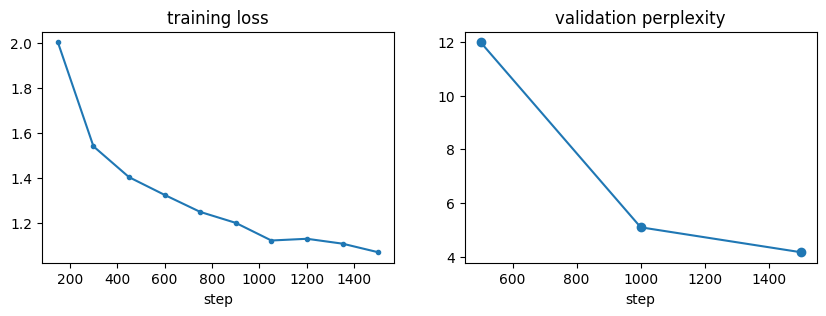
final validation perplexity: 4.18
Generating text
Section titled “Generating text”A decoder writes one token at a time, and each new token attends to every token before it. The KV cache stores the keys and values of every earlier position, so the prompt runs through the model once and each later step runs only the newest token.
generate runs that loop compiled. Sampling sets the temperature and top-k: temperature 0 always takes the most likely byte, and higher temperatures pick more freely. We sample from the EMA weights, state.averaged.
from dew.sampling import Sampling, generate
prompt = jnp.asarray([tokenizer.encode(PROMPT)], jnp.int32)out = generate(model, state.averaged, prompt, max_new_tokens=MAX_NEW_TOKENS,               key=jax.random.key(1), sampling=Sampling(temperature=0.8, top_k=40))print(tokenizer.decode(out.tokens[0]))
ROMEO: Tut Tybalt, Gracious fazous to deparal, Your bring shall be find that is in the sign, Why both his hardy nundrest to an all ment. RICHMOND: Let must be, my lord, if you that day: But yea, sir, then time and with himself; Her oft protection to his death to the supper your mother married to men. HERMIONE: And not that his by the duke a heaveness. Third I change it another canst thou beast; When
Greedy decoding (temperature 0) always picks the most likely byte. It tends to fall into a loop, as it does below after one line, which is why sampling is usually preferred for text like this.
greedy = generate(model, state.averaged, prompt, max_new_tokens=200, key=jax.random.key(0), sampling=Sampling(temperature=0.0))print(tokenizer.decode(greedy.tokens[0]))ROMEO: The sear that shall be the seat of the seas, And the strain the seat of the seat of the seas, And the strain the seat of the seat of the seas, And the straight the seat of the seat of the seas, And t
Reloading the checkpoint
Section titled “Reloading the checkpoint”fit wrote a checkpoint to RUN_DIR at the end of training: the weights, the EMA, the optimizer state, the step counters and the position in the data. A new Trainer over the same objective restores it with place(), and greedy decoding from the restored weights gives the same text.
restored, _, _ = Trainer(objective, optax.adamw(schedule), key=jax.random.key(SEED), checkpoints=Checkpoints(RUN_DIR)).place()again = generate(model, restored.averaged, prompt, max_new_tokens=200, key=jax.random.key(0), sampling=Sampling(temperature=0.0))print("restored step:", int(restored.step))print("same greedy text:", bool(np.array_equal(again.tokens, greedy.tokens)))Resumed from step 1500 in /content/nb/runs/05-lm restored step: 1500 same greedy text: True
Where to go next
Section titled “Where to go next”tools/tokenize_text.py in the repository writes the same three token files for any text file or folder, with the byte tokenizer or a Hugging Face one. recipes/lm/train.py runs this training from the command line. Notebook 07 trains this kind of model on several devices at once, and notebook 08 starts from a pretrained decoder instead of random weights.