
Post-training
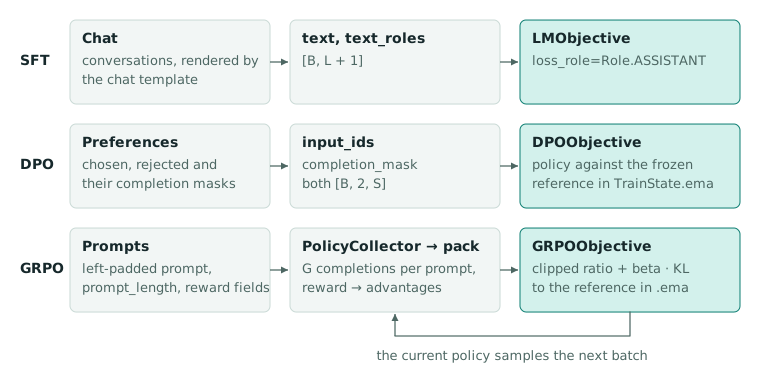
Post-training changes how a trained model behaves. Each method in Dew is an objective that runs on the ordinary Trainer, and the methods differ in the supervision their batches contain.
| Method | Supervision | Data | Objective |
|---|---|---|---|
| Supervised fine-tuning (SFT) | Example answers | presets.sft, or rows with text_roles | LMObjective(loss_role=Role.ASSISTANT) |
| Direct preference optimization (DPO) | A preferred and a rejected answer to one prompt | presets.preferences | DPOObjective |
| Group-relative policy optimization (GRPO) | A reward on answers the model samples | presets.prompts and RolloutScheduler.sampled, or a scheduler over any session source | GRPOObjective |
| Proximal policy optimization (PPO) | A reward, plus a learned critic | EpisodeCollector and PPORollout | PPOObjective |
| Flow-GRPO | A reward on samples from a rectified-flow model | FlowRollout | FlowGRPOObjective |
DPO and GRPO (with beta > 0) keep the starting weights as a frozen reference. Language models covers next-token training, and Objectives how models, objectives and the trainer fit together.
Example
Section titled “Example”The example builds a small byte-level decoder and runs a short SFT stage, then DPO, then GRPO, each starting from the previous stage’s weights. It starts from a fresh initialization in place of a pretrained model, so it downloads nothing.
import itertoolsimport json
import jaximport jax.numpy as jnpimport numpy as np
from dew import Trainerfrom dew.optim import OptimConfigfrom dew.data.dataset import Loaderfrom dew.data import ByteTokenizer, Memory, presetsfrom dew.data.chat import Rolefrom dew.nn.backbones import CausalTransformerfrom dew.objectives.lm import LMObjectivefrom dew.objectives.rl import DPOObjective, GRPOObjective, RolloutSchedulerfrom dew.sampling import Sampling
tokenizer = ByteTokenizer()model = CausalTransformer(vocab_size=tokenizer.vocab_size,                          emb_features=64, num_layers=2, num_heads=2, mlp_features=256,                          max_seq_len=64)base = model.init(jax.random.key(0), jnp.zeros((1, 8), jnp.int32))
base is a full Flax variables mapping, including its outer params collection, which is what every objective’s variables argument takes.
Supervised fine-tuning
Section titled “Supervised fine-tuning”Each token has a role. The prompt’s tokens are Role.USER and the response’s tokens are Role.ASSISTANT. With loss_role=Role.ASSISTANT, the loss counts only assistant targets, and the prompt tokens are still there as context.
prompt = tokenizer.encode("Tom had a red ball.")response = tokenizer.encode(" He kicked it.")row = np.array(prompt + response, dtype=np.int32)roles = np.array([Role.USER] * len(prompt) + [Role.ASSISTANT] * len(response), dtype=np.int8)sft_batch = {"text": np.tile(row, (8, 1)), "text_roles": np.tile(roles, (8, 1))}sft_data = Loader(train=lambda partition: itertools.repeat(sft_batch), val=None, records=8, batch=8)sft_objective = LMObjective(model, seq_len=len(row) - 1, variables=base, loss_role=Role.ASSISTANT)sft_state = Trainer(sft_objective, OptimConfig(learning_rate=1e-3), key=jax.random.key(1)).fit( sft_data, steps=20, log_every=10)Training CausalTransformer from step 0 to 20: 147,904 parameters, on 1 × cpu, batch 8, float32step 10/20 loss 1.136 ce 1.136 perplexity 3.115 token_accuracy 92.9% step_time_ms 19.51 samples_per_sec 410.1 accepted 100.0%step 20/20 loss 0.2127 ce 0.2127 perplexity 1.237 token_accuracy 100.0% step_time_ms 13.53 samples_per_sec 591.3 accepted 100.0%Trained 20 steps in 0:00:01: first step after 1.08 s, then 84.1 step/s17.3% of the wall time in steps, final loss 0.2127Preference optimization
Section titled “Preference optimization”A pair is two sequences with the same prompt, one followed by the chosen response and the other by the rejected one. The masks mark response tokens with 1.
rejected = tokenizer.encode(" He kicked kicked.")pair = {"chosen": prompt + response, "rejected": prompt + rejected, "chosen_mask": [0] * len(prompt) + [1] * len(response), "rejected_mask": [0] * len(prompt) + [1] * len(rejected)}width = max(len(pair["chosen"]), len(pair["rejected"]))pairs = Memory([pair] * 8).repeat().pipe(presets.preferences, seq_len=width, batch=8)dpo = DPOObjective(model, seq_len=width - 1, beta=0.1, variables=sft_state.variables)dpo_state = Trainer(dpo, OptimConfig(optimizer="adam", learning_rate=1e-3), key=jax.random.key(2)).fit( pairs, steps=10, log_every=5)Training CausalTransformer from step 0 to 10: 147,904 parameters, on 1 × cpu, batch 8, float32step 5/10 loss 0.03523 accuracy 1.000 rewards/chosen -1.711 rewards/rejected -5.039 step_time_ms 68.22 samples_per_sec 117.3 accepted 100.0%step 10/10 loss 0.008948 accuracy 1.000 rewards/chosen -3.645 rewards/rejected -8.357 step_time_ms 36.17 samples_per_sec 221.2 accepted 100.0%Trained 10 steps in 0:00:03: first step after 2.58 s, then 29.9 step/s10.5% of the wall time in steps, final loss 0.008948DPOObjective and GRPOObjective score tokens through TokenScorer, the scoring machinery LMObjective also builds on. Besides their own loss arguments they take its options: head_chunks, head_tile, samples, variables, processor and balance, the MoE router training ExpertBalance describes (dew.objectives.routing). PPOObjective takes balance and passes it, with its other policy options, to its actor. The language-model loss’s own options (ema_decay, pad_id, token_accuracy, loss_role, mtp_weight, z_loss, indexer) are LMObjective’s alone.
The preset’s seq_len is the full row width; shorter rows are padded to it, and the objective scores one position fewer because of the next-token shift.
Reinforcement learning with a reward function
Section titled “Reinforcement learning with a reward function”GRPO samples a group of completions per prompt, scores each with a reward function and trains on their rewards relative to the rest of the group. The prompt batch uses the numeric layout presets.prompts produces, with the reward metadata as UTF-8 bytes. The reward here counts the alphabetic characters in the decoded completion and divides the count by 8, the response budget in bytes, so an 8-byte completion of letters scores 1.
story = tokenizer.encode("Once upon a time")prompt_batch = {    "prompt": np.tile(np.array(story, dtype=np.int32), (8, 1)),    "prompt_length": np.full(8, len(story), dtype=np.int32),    "data_source": np.tile(np.frombuffer(b"stories", np.uint8).astype(np.int32), (8, 1)),    "ground_truth": np.zeros((8, 0), dtype=np.int32),    "extra_info": np.zeros((8, 0), dtype=np.int32),}

def reward(completion, record):    return sum(character.isalpha() for character in completion) / 8

rl_data = Loader(train=lambda partition: itertools.repeat(prompt_batch), val=None,                  records=8, batch=8)rl_objective = GRPOObjective(model, seq_len=len(story) + 7, beta=0.01,                             variables=dpo_state.variables)rollout = RolloutScheduler.sampled(rl_objective, reward, groups=4, max_new_tokens=8,                                   sampling=Sampling(temperature=1.0, top_k=40),                                   decode=tokenizer.decode)rl_state = Trainer(rl_objective, OptimConfig(learning_rate=1e-4), key=jax.random.key(3),                   rollout=rollout).fit(rl_data, steps=4, log_every=2)print(int(rl_state.updates), "GRPO updates")
Training CausalTransformer from step 0 to 4: 147,904 parameters, on 1 × cpu, batch 8, float32step 2/4 loss 2.411e-05 actor/pg_clipfrac 0 actor/pg_clipfrac_lower 0 actor/ppo_kl -2.724e-08 kl 0.002410 mismatch/ess 0.9915 mismatch/k3_kl 0.1831 mismatch/kl 0.6687 pg 5.122e-09 data_wait_ms 0.02618 grad_norm 2.673 compiles 1.000 cache_hits 34.00 cache_misses 0 step_time_ms 115.3 samples_per_sec 277.4 rollout_seconds 1.198 accepted 100.0% learning_rate 1.000e-04 groups 8.000 lag 0 lag/max 0 lag/mean 0 latency/max 0.02642 latency/p50 0.02635 latency/p90 0.02641 latency/p99 0.02642 length/mean 8.000 masked/cancelled 0 masked/infra_error 0 merge/calls_per_chain 1.000 pack/fill 100.0% resubmitted 0 reward/mean 0.2891 reward/observed 0.2891 status/agent_error 0.0% status/cancelled 0.0% status/completed 0.0% status/infra_error 0.0% status/truncated 100.0% waited_seconds 0.001096step 4/4 loss 2.890e-04 actor/pg_clipfrac 0 actor/pg_clipfrac_lower 0 actor/ppo_kl -9.337e-08 kl 0.02889 mismatch/ess 0.9893 mismatch/k3_kl 0.1685 mismatch/kl 0.6371 pg 8.754e-08 data_wait_ms 0.03642 grad_norm 2.726 compiles 1.000 cache_hits 34.00 cache_misses 0 step_time_ms 42.24 samples_per_sec 757.6 rollout_seconds 0.1208 accepted 100.0% learning_rate 1.000e-04 groups 8.000 lag 0 lag/max 0 lag/mean 0 latency/max 0.02908 latency/p50 0.02900 latency/p90 0.02906 latency/p99 0.02908 length/mean 8.000 masked/cancelled 0 masked/infra_error 0 merge/calls_per_chain 1.000 pack/fill 100.0% resubmitted 0 reward/mean 0.3672 reward/observed 0.3672 status/agent_error 0.0% status/cancelled 0.0% status/completed 0.0% status/infra_error 0.0% status/truncated 100.0% waited_seconds 0.001105Trained 4 steps in 0:00:03: first step after 2.74 s, then 15.9 step/s6.4% of the wall time in steps, final loss 2.890e-044 GRPO updatesEach prompt produces four completions, and decode turns each one into the text the reward reads. seq_len covers the prompt and the 8 response tokens, less one for the next-token shift. beta sets the coefficient of the KL term against the frozen reference. In one Colab run, 20 such steps trained a TinyStories decoder (Language models) with a reward of 1 for a completion that mentions a dog. Before training, 3 of 128 sampled completions mentioned a dog; after the 20 steps, all 128 did.
recipes/chain.py connects pretraining, SFT, distillation, DPO, GRPO and PPO stages (Stage chains).
Supervised fine-tuning
Section titled “Supervised fine-tuning”An SFT conversation is a list of messages, each with a role. presets.sft reads conversations from any dataset: a Parquet or .jsonl file (Files), a Hub dataset (Hub) or records in memory (Memory). Each row holds one list of messages in the column named by messages (default messages). If the data has no such column but has a prompt column, as verl’s layout does, the preset reads the messages from prompt. Tool schemas, where a row has any, go in a tools column. One row in the verl layout:
prompt = [ {"role": "user", "content": "What is two plus two?"}, {"role": "assistant", "content": "Four."}]| Setting | Default | Meaning |
|---|---|---|
tokenizer | required | Hub name or local path of a tokenizer with a chat template. |
seq_len | required | Prediction length L. |
batch | required | Rows per batch. |
messages | messages | Column holding each row’s messages. |
long | chunk | Chunk an over-length conversation, every turn kept; truncate keeps its first window and drop rejects it. |
pack | first-fit | How conversations share rows, as presets.lm packs documents. |
Held-out conversations are a part of holdout, or a dataset of their own, through the same preset.
The chat template is the rule for turning message boundaries, role headers and content into tokens, and each model is trained on its own format. Joining message strings by hand can change both the input and which tokens count toward the loss. The preset also preserves tool calls, tool responses and tool schemas.
Dew renders the conversation one prefix at a time to give each token a role. For an assistant turn, it leaves the generation header out of the assistant span. It checks that each tokenized prefix matches the start of the longer render, and raises if the template changes earlier tokens. This check does not guarantee correct assistant masks for every chat template or string delimiter, so look at the rendered tokens and roles for some typical conversations before a real run. Conversations must start with a system or user message; one that starts with an assistant message is rejected.
ds.pipe(presets.sft, tokenizer, seq_len=L, batch=B) packs conversations into these arrays:
| Field | Shape | Meaning |
|---|---|---|
text | [B, L + 1] | Token IDs, including the extra next-token target. |
text_roles | [B, L + 1] | Role value at each token. |
text_coordinates | Coordinates, [B, L + 1] leaves | Each token’s packed conversation and its position in it (dew.batch.Coordinates). |
Train with LMObjective(model, L, loss_role=Role.ASSISTANT). The objective shifts IDs and roles together: input position i predicts token i + 1, and the role of the target decides whether that prediction counts. It also skips padding and the transitions between packed documents. With loss_role set, a batch without text_roles raises. Keep evaluation conversations out of the training file; Evaluation and tracking covers what token metrics measure.
Direct preference optimization
Section titled “Direct preference optimization”DPO compares how much the policy prefers one answer over the other with how much a fixed reference policy does. The policy is the model being updated; the reference is a snapshot of its starting parameters. For each prompt, the chosen and rejected sequences hold the prompt followed by their own completion, and completion masks mark answer tokens with 1 and prompt tokens with 0.
presets.preferences reads any dataset of pairs: a file, a Hub dataset or records in memory. Each row has chosen, rejected, chosen_mask and rejected_mask; each mask is as long as its ID list. Without a mask, every token counts as a completion token. Give explicit masks for prompt-and-answer data.
A loaded batch holds input_ids and completion_mask, both [B, 2, S]. Index 0 of the middle axis is the chosen sequence and index 1 the rejected one. Shorter rows are right-padded to S (pad_id, default 0) with mask weight zero; rows that are too long raise. The preset’s seq_len is the full row width S, so use DPOObjective(model, seq_len=S - 1).
The objective sums the next-token log-probabilities over each completion and applies the log-sigmoid preference loss. beta (default 0.1) must be positive; it scales the comparison between policy and reference. Validation measures the perplexity of the chosen answers under the policy, which alone does not measure how often the preferred answer wins or how good the responses are.
Offline DPO example
Section titled “Offline DPO example”This block runs in a fresh process. The made-up vocabulary has eight tokens: IDs 1 and 2 (or 1 and 6) form the prompt, 3 is the preferred answer, 4 the rejected answer and 5 ends the answer, which counts toward the completion loss. Repeating the two pairs gives a batch of eight, which also divides across eight local devices.
import json
import jaximport numpy as np
from dew import Trainerfrom dew.optim import OptimConfigfrom dew.data import Memory, presetsfrom dew.nn.backbones import CausalTransformerfrom dew.objectives.rl import DPOObjective
rows = [    {"chosen": [1, 2, 3, 5], "rejected": [1, 2, 4, 5],     "chosen_mask": [0, 0, 1, 1], "rejected_mask": [0, 0, 1, 1]},    {"chosen": [1, 6, 3, 5], "rejected": [1, 6, 4, 5],     "chosen_mask": [0, 0, 1, 1], "rejected_mask": [0, 0, 1, 1]},]row_width = 4data = Memory(rows * 4).repeat().pipe(presets.preferences, seq_len=row_width, batch=8, pad_id=0)model = CausalTransformer(vocab_size=8, emb_features=16, num_layers=1,                          num_heads=2, mlp_features=32, max_seq_len=row_width)objective = DPOObjective(model, seq_len=row_width - 1, beta=0.1)trainer = Trainer(objective, OptimConfig(optimizer="adam", learning_rate=1e-3).build(2), key=jax.random.key(0))initial = trainer.initial_state()# Copy the snapshot to host memory before training donates device buffers.reference = jax.tree.map(lambda x: np.array(x, copy=True), initial.ema)state = trainer.fit(data, steps=2, log_every=1)for before, after in zip(jax.tree.leaves(reference), jax.tree.leaves(state.ema), strict=True):    np.testing.assert_allclose(before, np.asarray(after), rtol=0, atol=1e-6)print("Completed", int(state.updates), "DPO updates; reference stayed fixed.")
Training CausalTransformer from step 0 to 2: 2,752 parameters, on 1 × cpu, batch 8, float32step 1/2 loss 0.6931 accuracy 0 rewards/chosen -2.384e-08 rewards/rejected 0 step_time_ms 35.71 samples_per_sec 224.0 accepted 100.0%step 2/2 loss 0.6703 accuracy 1.000 rewards/chosen 0.03338 rewards/rejected -0.01294 step_time_ms 1.349 samples_per_sec 5,928 accepted 100.0%Trained 2 steps in 0:00:01: first step after 1.44 s, then 442.7 step/s0.2% of the wall time in steps, final loss 0.6703Completed 2 DPO updates; reference stayed fixed.fit builds its state inside a compiled function, so its copy of the reference can differ from the eager initial_state() by float rounding (1.8e-7 at most on an L4). The tolerance of 1e-6 allows that rounding and still fails if an optimizer step moves the reference, because one Adam step at this learning rate moves weights by about 1e-3. For a real dataset, build both sequences with the same tokenizer and chat format, check that they share the prompt, and take the masks from known token boundaries rather than from a character offset found by searching the string.
Reference memory
Section titled “Reference memory”The DPO reference is kept in TrainState.ema with its decay fixed at 1, so it never changes, and DPOObjective refuses an ema_decay argument. rewards/chosen and rewards/rejected are beta times each side’s sequence log-ratio of policy over reference, so a policy that has not moved yet reports zero rewards and no wins. The reference is not a second model object and the optimizer never updates it, but it is still a separate parameter tree with its own forward passes. Budget memory for the policy parameters, reference parameters, optimizer state, gradients, activations and batches.
SFT keeps no moving average unless ema_decay is set, as the language-model objective does. GRPO keeps a frozen reference only when beta > 0, and refuses ema_decay too. When a DPO or GRPO stage starts, its starting variables become the frozen reference.
GRPO needs a stream of prompts and a reward function before it can build a training batch. presets.prompts reads any dataset of prompts, such as a Parquet file in the verl layout or JSON records, with prompt, data_source, ground_truth and extra_info. A prompt can be token IDs, a string or a list of role and content messages. A string is encoded as it is, without added special tokens. With tokenizer="byte" it is encoded with Dew’s local UTF-8 vocabulary, and with any other name by that Hugging Face tokenizer.
Messages go through the Hugging Face tokenizer’s chat template, and thinking sets a reasoning template’s enable_thinking. An optional tools column holds tool schemas, which are rendered into the prompt tokens. Missing reward fields become empty strings, and reward metadata that is not a string is passed on as JSON text.
from dew.data import Memory, presets
data = Memory([{"prompt": "dew"}] * 8).repeat().pipe(presets.prompts, "byte", max_prompt_len=8, batch=8)
The preset produces left-padded prompt IDs of shape [B, P] and prompt_length of shape [B], where P is max_prompt_len. A prompt that is too long is cut from the front, so its end is kept. The metadata columns are stored as fixed-width UTF-8 byte arrays, and prompt_tasks turns them back into each row’s PromptRecord for the reward:
reward(completion: str, record: PromptRecord) -> floatPromptRecord (dew.objectives.rl) holds the row’s data_source, its ground_truth as the source normalized it, and its extra_info, each the empty string where the row has none; a reward reads the fields it needs. A verl compute_score(data_source, solution_str, ground_truth, extra_info) enters through dew.objectives.rl.verl.verl_reward, and compute_score(reward) there hands a Dew reward to verl.
Pick a reward whose score can be checked independently of training; for an exact-answer task, compare the decoded completion with the ground truth under a normalization rule you write down. decode defaults to token IDs separated by spaces, not natural-language text, so a reward that reads text needs the tokenizer’s decode function.
RolloutScheduler.sampled argument | Default | Meaning |
|---|---|---|
objective | required | The GRPOObjective whose policy samples. |
reward | required | The reward callable above. |
decode | IDs joined by spaces | Turns sampled IDs into the reward’s text. |
groups | 4 | Completions per prompt, G; at least 2. |
max_new_tokens | 32 | Response budget, R. |
estimator | "group" | Advantage estimator: "group", "mean" (only centres, Dr.GRPO) or "rloo" (each against the rest of its group). |
truncation | "score" | What a completion that ran out of budget does: "score", "mask" or "zero" (Sessions and packed rows). |
sampling | Sampling() | Temperature, top-k, top-p, min-p and EOS IDs. |
The trainer calls the rollout on the host before the compiled update. The rollout turns each completion into a one-call Session and builds the batch with pack, so the batch has the same layout as every other GRPO batch in Dew. With N = B * G, every column is [N, P + R] and aligned with input_ids. Each chain is a prompt without its padding followed by the sampled response, and several chains may share a row.
| Field | Meaning |
|---|---|
input_ids, text_segment_ids, text_positions | The chains, which chain each ID belongs to, and its position in that chain. |
response_mask | 1 on sampled IDs, EOS included. |
old_log_probs | Raw model-policy likelihoods recorded at each sampled ID. |
behavior_log_probs | Actual temperature/top-k sampling likelihoods. |
advantages | The completion’s advantage repeated across its chain. |
versions, session_index, call_index | The policy version, the completion (row * G + group) and its call, on sampled IDs. |
Use GRPOObjective(model, seq_len=P + R - 1), and give the decoder enough context for P + R tokens. With the default truncation="score", every completion is scored, whether it stopped on EOS or on the budget.
GRPOObjective argument | Default | Meaning |
|---|---|---|
beta | 0.0 | k3 KL penalty against the frozen reference; > 0 keeps the reference. |
epsilon_low, epsilon_high | 0.2, 0.2 | Clipping range of the policy ratio. |
dual_clip | 3.0 | Dual-clip bound for negative advantages. |
policy_loss | "ppo" | "ppo", "gspo" or "cispo". |
aggregation | "token-mean" | "token-mean" or "session-mean". |
behavior_importance | None | Token TIS cap, or an IcePop (lo, hi) band. |
sequence_mask, geometric_mask | None | Chain rejection by summed or mean k1. |
sampling_temperature | 1.0 | Temperature the sampled IDs are scored at. |
Pass sampling=Sampling(eos_token_ids=..., temperature=..., top_k=...); eos_token_ids takes one ID or a tuple. The response mask includes EOS; the text passed to the reward leaves out EOS and padding. The rollout turns prompt_length into the standard ModelInputs attention mask.
Generation prefills the padded batch once and packs the real tokens into each row’s cache, so prompts of different valid lengths reuse the same compiled shape. After a row hits EOS, later steps leave its cache unchanged. Rescoring reads each chain on its own through its segment IDs and positions. GRPO validation scores prompt perplexity over real next-token transitions; it does not generate answers for a separate reward evaluation.
old_log_probs holds the raw policy likelihoods from the cached forward pass at sampling time, and behavior_log_probs the likelihoods after temperature and top-k. For greedy sampling, the chosen action has a behavior log-probability of zero. GRPO’s PPO ratio compares the current raw policy with the old raw policy. A correction from behavior policy to proximal policy is a separate algorithm choice, applied only on request.
GRPOObjective(..., behavior_importance=2.0) applies detached, token-level truncated importance weights from the recorded raw old policy to the recorded behavior policy; the default None keeps the uncorrected loss. On supported actions the weight is min(exp(clip(old_raw - behavior, -20, 20)), cap). It multiplies the policy-surrogate terms before the usual reduction over token count. PPO clipping still compares the current policy with the raw old policy, and the KL term does not change. Missing or misaligned behavior likelihoods are refused. This follows verl’s token TIS implementation at revision d040717b21af2e23e8e789a3e354cff2394ae2de, and tools/parity_behavior.py checks it against the installed reference. Truncation, token-level weighting and filtered action support mean this is not an unbiased estimator of the raw policy over full trajectories.
Tool episodes
Section titled “Tool episodes”dew.objectives.rl.EpisodeCollector collects multi-turn episodes from an environment you supply and an inference policy that can be bound to a set of weights, and RolloutScheduler.episodes(policy, environment, verifier, ...) trains on them through the ordinary Trainer(rollout=...) hook and GRPOObjective. It does not pick an executor for you. Pass dew.inference.TextGeneration(model, variables) as its policy. Collection calls policy.bind(snapshot) once. Each call after that receives the exact context token IDs, a response budget, a key and Sampling, and returns a Generation with raw and behavior log-probabilities. Canvas generation is not an autoregressive policy and cannot supply these likelihoods.
The input dataset yields integer task_id rows. Your environment factory receives an EpisodeId with the task, the attempted step, the sample index and a random seed, and returns an Environment to use as a context manager. Its reset() returns an Observation with the first context. step(action) takes a finished model turn and returns either the exact next context or a terminal result. The environment is responsible for decoding, validating tool calls, chat formatting, execution, timeouts and cleaning up resources. Dew itself never executes generated code by default.
SubprocessEnvironment(command, limits), in dew.rl.sandbox, is one environment factory you can use. It starts the argv command in its own session and temporary directory and exchanges JSON lines with it. A reset message holds the episode identity, and a step message holds the action’s context, tokens, termination flag and policy step. Each reply has context, status and detail, and an optional number reward, the step’s reward (Observation.reward).
SandboxLimits sets RLIMIT_CPU and RLIMIT_AS in the worker, and a wall-clock deadline per session and a message size cap in the parent. On exit, Dew kills the worker’s process group, and the worker gets SIGKILL if the parent dies. The worker runs with the caller’s OS permissions and has no filesystem or network isolation, so untrusted code needs an outer sandbox. tests/test_sandbox.py runs a real worker through round trips, a hang, an exceeded memory limit, a crash, malformed output, parent death and a full EpisodeCollector cohort.
Observation.status tells apart running, completed, truncated, cancelled and error outcomes. Model EOS ends an action, and the environment decides when the episode ends. A response that hits its token limit without EOS is recorded as truncated and is not sent to a tool. A context longer than max_prompt_tokens also truncates the episode, without cutting off the input already recorded. max_turns limits the number of model calls.
The verifier takes an Episode and returns a finite scalar reward. It sees the termination status, the result detail and every Transition(action, observation), so it can score finished and truncated outcomes differently. An environment may also pay a step reward with each observation (Observation.reward), which becomes the reward of the call it paid for (Call.reward). An episode’s return is the verifier’s reward plus every step reward its calls earned. Group-relative advantages are computed over episodes of the same task. With RolloutScheduler.episodes(..., credit="session"), the default, every action token of an episode shares its episode’s advantage. With credit="turn", each turn compares the members’ returns from that call on, at the same call index within the task’s group, counting only the members that made a call at that turn, and each call’s actions take their own advantage. Exceptions, cancellation and verifier failures abort the group before any update. The optional record callback receives completed or failed host records. EpisodeFailure and EpisodeCancelled carry the partial episode.
Verification runs while the environment context is still open, so a verifier you write can inspect temporary files or a live sandbox. Resources are released after verification, whether it succeeded or failed. If release fails, the episode is thrown out instead of being scored.
Episodes go through the same packer as engine-sourced rollouts (Sessions and packed rows). session_of(episode, group=...) turns each episode into a Session whose calls are its actions. When the environment’s next context starts with the previous context plus the sampled actions, the two calls merge into one chain; any other context starts a new chain. Chains share rows max_prompt_tokens + max_new_tokens IDs wide, so set GRPOObjective.seq_len to that width minus one. The batch has BGK rows for B tasks, G samples and K turns, which always fits and keeps the shapes fixed.
Only sampled actions, EOS included, count toward the loss mass, and observations are never targets. Raw likelihoods go into old_log_probs and behavior likelihoods into behavior_log_probs, copied from the actual inference result, so no transcript is retokenized or rescored. Truncated episodes are masked out of the loss and left out of the group baseline.
Collection binds one snapshot of the variables until it returns. Every rank supplies the same number of task rows and agrees on budgets, sampling and clocks before it opens any environment. All local episode slots are sampled together in each round. Finished slots keep their global row positions with inert prompts whose outputs are thrown away, so episodes with different turn counts do not change the order of collectives or the random draws. Ranks agree on a tool, reset or verifier failure before the next generation, and every rank releases the environments it opened. The committed update clock stays in policy_step, and the attempted-work clock in the episode identities. Continuing from a checkpoint restores the Trainer and the input iterator.
Each episode records an internal origin identity of the collection that drew it, which the journal checks before it resumes a cohort, so records from policies bound separately are never mixed even when their attempt and update clocks match. You do not set this identity, and it is not a hash of the weights. The identity does not affect random draws or whether replayed public records compare equal.
Both asyncio and concurrent-futures cancellations raise EpisodeCancelled with CANCELLED status. The original cancellation object is kept as its __cause__, and the environment exits under that original exception before the wrapper is raised. Cancelled observations that the environment returns itself have no source exception.
tests/test_tool_episodes.py trains a small policy that samples a call to a square tool, receives the computed result and samples a final answer. It checks categorical gradients on actions only, raw and behavior probabilities, resource cleanup, failures and cancellation, and that Trainer updates match with and without a checkpoint restore. These tests run offline and check the lifecycle and the numbers. They do not show that a remote sandbox works.
tests/test_episode_pool.py runs two real CPU processes with different episode turn counts. Their actions, likelihoods, packed arrays and updated parameters exactly match a single-process run on the same two global devices. It also runs a tool failure on one rank and a mismatched cohort configuration. Both end on all ranks together, without leaking any open environments.
The lifecycle matches the responsibilities in verl BaseTool: create, execute, calculate reward and release. verl’s multi-turn guide describes assistant-only masks and warns about differences caused by retokenization. Dew keeps each actual model call instead of rebuilding sampled tokens from message deltas. A remote sandbox adapter would also have to handle creation, timeout policy and termination, as the E2B Python SDK does. Dew bundles neither an E2B client nor a verl runtime adapter. SubprocessEnvironment covers only the local case with resource limits. For single-shot verification, SandboxFleet with ContainerRunner runs each program in a network-less container; see asynchronous RLVR.
verl rows
Section titled “verl rows”dew.objectives.rl.verl.to_verl(sessions) writes native verl AgentLoopOutput rows, one per strict chain of each session. A row holds the first call’s prompt followed by every sampled and in-between ID, with response_mask 1 on the sampled IDs. It also holds the engine’s behavior log probabilities (0.0 elsewhere), routed_experts when every call recorded routing, and min_global_steps and max_global_steps taken from the call versions.
from_verl(rows) reads verl’s own rows back. Each run of mask-1 IDs becomes one call, whose prompt is every ID before it and whose policy version is the row’s min_global_steps. Pass verl’s rollout.n as samples= to group rows the way verl repeats prompts. extra_fields.dew is optional; when Dew wrote it, it restores the session’s identity, status, finish reasons, versions and sampling supports exactly. A call that sampled nothing, such as one aborted before its first token, keeps its place.
A native row keeps its own min_global_steps and max_global_steps, and Dew writes its own only when a row had none. verl’s own extra_fields come back in VerlTrajectory.extras and are written out unchanged. Rows with media (multi_modal_data, mm_processor_kwargs, mm_processor_output) are refused, because Dew’s text trainer would score their placeholder IDs without the images or video. from_verl(rows, media=True) imports them for a round trip only. Import also refuses rows without behavior log probabilities, a version or a reward.
Live, imported and journal-restored draws all go through the same validation (Draw): a nonempty context, nonnegative integer token ids (booleans excluded), aligned finite likelihoods, and a termination flag that agrees with the configured EOS. Tokens after EOS are refused. Checking the upper bound against the vocabulary is left to the caller, which knows the model.
tools/verl_interop_reference.py writes the fixtures tests/test_verl_interop.py reads from verl revision 12ebe0cb4d300c58449fb6c675379e8700015c51, run in an isolated environment: four rows of verl’s gsm8k_tool_agent_loop.py parquet and two AgentLoopOutput dumps with their as_dict() tensors. One is a tool loop with routed experts. The other is a video turn whose mm_processor_output comes from build_sglang_video_payload. The test imports and re-exports verl’s rows unchanged, and checks that packing matches verl’s tensor mapping. presets.prompts reads the verl parquet’s reward_model.ground_truth, keeps tools_kwargs inside extra_info, carries ability there too, beside them, for the reward, and reads and drops agent_name. Dew does not import torch or verl at runtime.
Episode journal
Section titled “Episode journal”Set EpisodeCollector(..., journal=EpisodeJournal("run/episodes")), or RolloutScheduler.episodes(..., journal=...), to save sampled pending actions and completed turns in a SQLite WAL, one per rank. The environment must implement get_state() -> bytes and set_state(state: bytes) -> None. Those snapshots must hold the tool state and any workspace state that later calls or the verifier need. The subprocess adapter exposes these operations as JSON requests, with base64 state strings and a {"restored": true} acknowledgment. Environments without snapshots still work when you do not use a journal.
Recovery restores completed turns with their exact contexts, raw and behavior likelihoods, rewards and environment snapshots. Pending draws are saved before the tool runs and reused after a crash. A completed turn is committed before the next tool call or training update. An external effect that happens between a pending record and its completed commit can run twice, so the environment must use the episode identity and action to make such effects idempotent. The journal does not promise that arbitrary external effects happen exactly once, and it cannot resume in the middle of a tool call.
Use one journal directory per run. Recovery checks task identities, sampling controls, topology, training clocks, the key and a digest of the local policy shards. Computing that digest reads the local weights once per collection. The journal refuses concurrent writers, and refuses a different policy at the same clocks. SQLite commits in FULL synchronous mode keep turn boundaries intact. tests/test_episode_recovery.py kills a real two-device training process while a subprocess tool call is pending, restores it, and gets identical sampled actions and updated parameters. Its audit log confirms that each completed square call ran once.
Asynchronous RLVR
Section titled “Asynchronous RLVR”Reinforcement learning with verifiable rewards (RLVR) scores each completion by checking it: running the program it wrote against test cases, or comparing its final answer with a reference. RolloutScheduler runs GRPO rollouts from a SessionSource while the trainer updates, and SandboxFleet runs the checks. examples/train_rlvr.py puts them together.
Rollout servers
Section titled “Rollout servers”dew.inference.RolloutServer is the interface for a server that samples continuations of token prompts under a versioned policy. submit(prompt_ids, max_new_tokens, key=...) returns a future Draw with the sampled IDs, their behavior log-probabilities, the raw-policy log-probabilities when the backend has them, its finish_reason (stop where it terminated, length where its budget cut it), and the policy version the request was submitted under. A draw terminates on one of the Sampling’s EOS IDs or on the ID that completes one of its stop strings, and keeps that ID; otherwise its budget, or a criterion that truncates it such as MaxNewTokens, cut it. vLLM and SGLang match the stop strings on the text they decode and return the IDs through the completing one, as Dew’s own Server does; vLLM also keeps a speculative block’s IDs past it, so OpenAIRolloutServer takes the policy’s tokenizer (decode=) and cuts the draw at the first ID whose text completes the string. load(variables, version) pushes new weights. Generation continues across a push, so a draw’s version is that of the oldest weights that may have produced any of its tokens.
-
NativeRolloutServer(Server.from_task(objective.policy(params, sampling, Progress(version)), slots=..., capacity=...), version=version)drives Dew’s continuous-batchingServeron a background thread.loadcopies the trainer’s tree onto the served device in place (Server.reload) between two steps, casting floating leaves to the served precision, so you can train in float32 and serve in bfloat16; each version draws at the run’s progress at its updates (dew.nn.progress), as the trainer’s loss reads it. A server built from a task at the run’s end (Progressleft atEND) is refused for a model that reads the run’s progress, which would draw from another policy than the one it trains. Draws carry both raw and behavior likelihoods. -
OpenAIRolloutServer(OpenAICompletion(name, client, provider="vllm" or "sglang"), sampling, weights)posts token-ID prompts to a vLLM or SGLang completions endpoint. Each request has theSamplingcontrols, a seed,logprobs=0and the field that makes the engine return the sampled IDs:return_tokens_as_token_idsfor vLLM, which puts them in the logprob tokens, andreturn_token_idsfor SGLang, which lists them on the choice. So the draw holds the IDs the engine sampled, and no text has to be retokenized.The two engines report different distributions. vLLM reports raw model log-probabilities unless it runs with
--logprobs-mode processed_logprobs, so for vLLM the server refuses a transformingSampling(temperature other than one, top-k, top-p or min-p) unless you passprocessed_logprobs=True. A filteringSampling(top-k, top-p or min-p) also needs each draw’s kept IDs, which only vLLM’s token route returns, soOpenAIRolloutServerrefuses one for vLLM.SGLang’s
/v1/completionsreportslog_softmax(logits / temperature)before its top-k, top-p and min-p filters and has no field for the filtered likelihood. So for SGLang the server accepts any temperature and refuses every filter. SGLang’s native/generatedoes report the filtered likelihood underreturn_sampling_maskfor a finite top-k, and a filtered policy would need that route. LeaveSGLANG_RETURN_ORIGINAL_LOGPROBunset, because it switches SGLang to raw log-probabilities. SGLang honors the seed only under--enable-deterministic-inference.routing=Truereads vLLM’s per-choicerouted_expertsinto each draw for routing replay; start vLLM with--enable-return-routed-experts. Remote draws have no raw likelihood. -
VLLMGenerateServer(base_url, sampling, weights, routing=False)posts to vLLM’s token route,/inference/v1/generate, which returns the ids the sampler kept for every drawn token (sampling_mask) beside the filtered likelihoods, so a top-k or top-p policy trains on its recorded support. Start vLLM with--enable-scale-out(or--tokens-only),--return-sampling-mask,--logprobs-mode processed_logprobs, and--enable-return-routed-expertsforrouting=True. vLLM builds the mask only under a finite top-k, so the server refuses aSamplingwithout one. -
SafetensorsReload(pretrained, directory, engines, engine)publishes a policy version to every replica inengines, given as their root URLs. It writes the policy once withPretrained.savein bfloat16, stages the files besidedirectoryand moves each one in withos.replace, then runs the reload sequence on all replicas at once. Launch every replica on the same directory, written the first time bySafetensorsReload.write.For
engine="vllm"(checked against v0.30.0) it callsPOST /pause?mode=wait, which lets in-flight requests finish and schedules no new ones. Then it callsPOST /collective_rpc {"method": "reload_weights"},POST /reset_prefix_cache,POST /update_weight_version {"new_version": "v"}andPOST /resume. These are vLLM development endpoints, enabled byVLLM_SERVER_DEV_MODE=1, so expose them only on a trusted network. vLLM reports a reset that did not happen as HTTP 200 with{"success": false}, so the push fails unless the reset answers{"success": true}. A push that fails after the pause leaves vLLM paused, so that no draw comes from weights the push may have half loaded; the next successful push resumes it. The push runs each of these steps on every replica before the next step, and a step that fails on any replica stops it there, so no replica resumes on weights another may not hold.NCCLPushruns the same steps around its own delivery.For
engine="sglang"it makes one call,POST /update_weights_from_disk {"model_path": directory, "flush_cache": true, "abort_all_requests": false, "weight_version": "v"}. SGLang starts the load once every in-flight request has finished, holds new requests until the load returns, and flushes the radix cache before answering. So in-flight draws finish on the old weights, and the push takes as long as the longest of them. A failed SGLang load answers 400 with{"success": false}. The push fails on a status other than 200 or asuccessthat is not true, and SGLang then re-reads the same directory as its rollback. On either engine, a failed push leaves the server’sversionwhere it was.Publication(push, version=v0, stamp=gateway.stamp)turns a push into a versioned publisher. Itsload(variables, v)runs the push and then the stamp, and movesversiontovonly when both succeed. The stamp goes to a recording gateway (Gateway.stampposts rllm-model-gateway’s/admin/weight_version) only after every replica servesv. The gateway stamps each call with its version when the request arrives, so a stamp ahead of any replica would claim weights the call was not sampled from, while a stamp behind them only overstates the call’s lag. Construction touches no gateway. The first read ofversionstampsv0, the launch version, and the rollout scheduler reads it before it submits its first draw, so a stamp an earlier run left behind never labels this run’s calls. One lock orders that stamp against a load, so the gateway ends at the version the engines hold.On a multi-process trainer every process calls the push. The pool gathers the tree to host memory (
collective_host), process 0 writes and publishes, and all processes agree on the outcome, so a failed push raises on every process. -
NCCLPush(pretrained, engines, library)publishes to vLLM replicas without going through the disk. It sends the tensorsPretrained.savewould write (Pretrained.export) from one trainer GPU to each replica’s GPUs by NCCL broadcast. The broadcast runs over a group the trainer opens with each replica on the first push. To open it, the trainer creates the NCCL unique ID, posts it to/init_weight_transfer_engineand joins the group through ctypes, so the trainer does not need torch.libraryis the engine’s ownlibnccl.so.2(for a pip-installed vLLM,<venv>/lib/python3.12/site-packages/nvidia/nccl/lib/libnccl.so.2), because NCCL refuses a peer of another version.Launch vLLM with
--weight-transfer-config '{"backend": "nccl"}'andVLLM_SERVER_DEV_MODE=1(checked against v0.30.0). A push pauses each replica withmode=wait, then runs/start_weight_update,/update_weightswhile it broadcasts,/finish_weight_update, a reset of the prefix cache that must answer success, and/resume. Every process of a multi-process trainer calls it. The pool gathers the policy to host memory leaf by leaf, asSafetensorsReloaddoes. The process holding the mesh’s first device then exports the policy and sends it from that device, with at most twochunks (or two copies of its largest tensor) on the device at a time beside the trainer’s state.closeaborts the groups, because NCCL’s destroy would wait for the engine’s side, which the engine keeps open until it exits.On 4x RTX 3090 (PCIe 3.0, one host), with a three-process trainer on GPUs 0 to 2 and vLLM on GPU 3, a push of Qwen3-0.6B in bfloat16 (1.1 GiB) took 6.8 to 7.3 s (the gather 4.6 to 5.1 s, the export 1.2 s, the broadcast 0.9 s), and a
SafetensorsReloadtook 8.7 to 9.8 s. After either one, the engine’s prompt log-probabilities for the same weights were identical. Pushing the launch weights back reproduced the engine’s first answers exactly, and a policy with itsdown_projhalved moved them by up to 8.5 nats. -
HarnessSource(harness, Gateway(url, sandbox_url=...))indew.interop.harnessruns each sample as one trial of an agent harness: a command whose agent reaches the model through rllm-model-gateway at its own session’s/sessions/{session}/v1(dew.interop.gateway), and whose calls the source reads back from the gateway’s traces.Harbor(harbor=..., model=..., trials=...)indew.interop.harborruns a Harbor trial, andexamples/train_harbor.pytrains with it;Command(argv, verify, workspace)runs any agent CLI that readsOPENAI_BASE_URL, in a fresh working directory, and scores the directory it leaves withverify. Harbor bounds a trial’s environment build, agent and verifier itself (--agent-timeout,--verifier-timeout,--timeout-multiplier), but nothing of its own bounds the whole trial;trial_timeout=Sdoes, interrupting a trial still running afterSseconds as a cancel does and resolving itINFRA_ERROR. A cancel or a deadline signals the trial’s whole process group, SIGINT, then SIGTERM and SIGKILL agraceapart, while its output is open; output still open agraceafter the SIGKILL is held by a process that left the group, which keeps running, and the trial stops reading it. A cancel stops the harness, not a model call the engine is still decoding for it: rllm-model-gateway (3b40c37) keeps a non-streaming call’s upstream connection after its client goes (rllm-org/rllm#938), so that call runs on to its token budget. The gateway has no authentication, and the port that proxies model calls also serves every session’s traces and its admin routes (/admin/workers,/admin/weight_version).Sandboxes run the policy’s commands, so they must never reach that port. Keep
urlon an interface only the trainer can reach, and give the sandboxes asandbox_urlthat is a reverse proxy forwarding onlyPOST /sessions/<session>/v1/chat/completions. Then restrict the task’s agent phase to that proxy with Harbor’snetwork_mode = "allowlist"(allowed_hosts, or--allow-agent-host). Harbor’s allowlist filters hosts and not paths, so the proxy is what keeps the admin and trace routes out of reach. -
Dew does not start the gateway or its engines; it connects to the ones you run. Two steps keep the gateway from turning a busy engine into failed trials. First, warm each engine before the gateway takes traffic, by sending one short chat request of each shape you will serve (with and without tools) straight to the engine. SGLang 0.5.20 spent 108 s compiling on its first chat request on an L4, and during that time its
/healthdid not answer.Second, rllm-model-gateway (3b40c37) marks a worker dead after 3 failed health probes of 5 s each, and while no worker is healthy it answers every call with a plain-text 500 and records nothing. Only the probe interval can be configured, so set
health_check_intervalto make 3 × interval longer than the longest stall you expect. Sixty seconds covers the 108 s compile.HarnessSourcechecks the gateway before its first submission (Gateway.ready). It waits up toready_timeoutseconds for/health/workersto report a healthy worker and forGET /v1/modelsto answer through the gateway. A worker that goes dead later in the run shows up asINFRA_ERRORsessions, which the scheduler retries. A gateway config for one engine on the trainer host:host: 127.0.0.1 # only Dew reaches it; sandboxes go through a path-restricted proxyport: 9090store_worker: memorysync_traces: true # traces are stored before the reply, so a finished harness has all of themhealth_check_interval: 60 # 3 failed probes = 3 minutes: longer than a first-request compileworkers:- url: http://127.0.0.1:8011/v1model_name: Qwen/Qwen3-0.6B
OpenAICompletion accepts token-id rows as prompts, and its Completion records per-choice tokens and log_probs when the engine reports them.
Rollout scheduler
Section titled “Rollout scheduler”RolloutScheduler(acquisition, tasks=..., groups=G) is the trainer’s Rollout over token sessions, however they are drawn. Synchronous(collector) draws each call’s sessions at the call from the variables the step trains: RolloutScheduler.sampled and RolloutScheduler.episodes build it over PolicyCollector and EpisodeCollector, every process of the trainer’s mesh enters the draw, a failed sample abandons its group, and old_log_probs are the raw likelihoods the collector drew, which are the proximal policy’s. Asynchronous(source, weights, objective, width=W, rows=N, max_lag=1, ahead=1, sync_every=1, max_attempts=3) keeps rollouts from any SessionSource in flight ahead of the trainer, as the rest of this section describes. Train on scheduler.tasks(dataset) with Trainer(..., rollout=scheduler). tasks turns a batch into Tasks; task_ids reads integer task_id rows, and prompt_tasks reads prompt rows.
The wrapped stream registers each batch as the trainer’s prefetch reads it. When the trainer gives the scheduler batch i, the scheduler submits batches i + 1 through i + ahead under the version weights serves at that moment. Batch i itself was submitted ahead calls earlier and has been running since. The scheduler reads nothing beyond the trainer’s prefetch, so the checkpointed data position is still the trainer’s. A resumed run re-reads and resubmits whatever was in flight, and reopening the stream cancels the rollouts the old stream left running.
Each task becomes one group of G rollouts. The scheduler relabels every admitted rollout with its own group ID, sample index and attempt, so a resubmitted sample rejoins its group. The scheduler admits rollouts as follows:
COMPLETEDandAGENT_ERRORrollouts are admitted with their verifier reward.TRUNCATEDrollouts complete their group and train astruncationsays ("mask"by default: no loss, no baseline; see Sessions and packed rows). Under"score", a truncation that arrives without a reward is submitted again as a failed attempt: its verifier never ran, which is an infrastructure failure, not an outcome of the policy.INFRA_ERRORandCANCELLEDrollouts are never scored. The sample is submitted again under the served weights, up tomax_attemptsfailures per sample, after which its group is abandoned.- A rollout whose oldest call is more than
max_lagupdates behind is discarded and submitted again. A rollout still running whose submission is already past that bound is cancelled without waiting for it.
The scheduler keeps no clock of its own. A deadline belongs to the operation that can stop when it passes: the remote rollout servers bound each request, a sandboxed environment (SubprocessEnvironment) its wall_seconds, and HarnessSource(..., trial_timeout=S) each harness trial. A rollout that runs out of time there comes back as INFRA_ERROR, and the scheduler retries it. A reward’s program past its sandbox’s wall clock is a TIMEOUT verdict that the reward scores, not a failure.
If a source raises instead of returning a status, Dew cancels the batch’s work and the exception propagates. Two settings cut the long tail without changing the batch shape. oversample=K runs G + K samples per group and admits the first G to finish, and admit=M admits the first M groups of a batch to complete and cancels the rest. Both select by completion time, which favors short rollouts. A rollout that is running when a push arrives keeps running. Its later calls have the new version, and its staleness is that of its oldest call.
The scheduler pushes weights through weights.load(params, updates) whenever the served version falls sync_every updates behind, so a first submission is at most ahead + sync_every - 1 updates stale. Construction refuses a max_lag below that. A push that does not move the served version is tried once more, and then the scheduler raises.
pack(sessions, W, rows=N) packs the admitted groups into fixed [N, W] rows with per-rollout advantages. A session whose calls do not extend each other packs as one chain per call, so a complete group is admitted only if its chains fit in N rows beside the groups admitted before it. Otherwise the group is cut, counted in the record, and the batch trains without it. Size N for the chains a group can split into, because a group that cannot fit its chains in N rows on its own raises, whatever order the groups finish in.
Asynchronously, old_log_probs is rescored under the trainer’s current weights, which serve as the proximal policy (AReaL). behavior_log_probs keeps what the engine reported, and GRPOObjective(behavior_importance=...), a TIS cap or an IcePop band, weights each token by proximal over behavior. Any schedule that allows lag needs this correction.
log receives a SchedulerRecord per call. It has the oldest admitted version and lag, admitted groups, resubmissions by cause, cancellations, abandoned and cut groups, seconds waited, and session_metrics over the admitted rollouts and their packed batch, with each rollout’s latency from submission to finish.
A multi-process trainer runs one scheduler per process. Each scheduler has its own source over the task rows its process’s data stream reads, and each packs its own N rows. The step’s batch is every process’s rows together, sharded as the trainer shards any batch, so no rollout crosses a process. The processes synchronize at the weight push, which every process calls and one process sends, and at the proximal rescoring, which runs once over the pool’s batch. An admission that fails on one process raises on every process at that point, so the others are not left waiting in the rescoring.
On 4x RTX 3090 (PCIe 3.0, one host), three trainer processes on GPUs 0 to 2 trained Qwen3-0.6B with GRPO from rollouts that vLLM drew on GPU 3, one task batch ahead (max_lag=1). After the first update no process waited more than 0.03 s for its rollouts, and eight updates took 161 s with NCCLPush and 229 s with SafetensorsReload.
Two sources run on a RolloutServer. PromptSource(server, reward, decode=..., max_new_tokens=R) draws one completion per sample and scores its decoded text on a thread pool as the draw finishes. A draw that ends on its budget is TRUNCATED. A draw the server cancelled, and an InfrastructureError or OSError from the draw or the reward, such as an unreachable engine or a container the reward could not start, is INFRA_ERROR. A non-finite reward or likelihood, or any other error of the draw, the decode or the reward, fails the rollout’s future, and the scheduler raises it. The remote rollout servers raise InfrastructureError when the engine cannot be reached, times out, or answers 5xx or 429. InfrastructureError (dew.inference) is also how a reward, verifier or environment reports a failure of its own external boundary that is not an OSError: requests and urllib errors are OSErrors, but an httpx or SDK transport error is not, so raise InfrastructureError from it.
EnvironmentSource(server, environment, verifier, max_prompt_tokens=P, max_new_tokens=R, max_turns=T, workers=N) runs the in-process Environment protocol of tool episodes, one session per sample on a worker thread. Each turn submits the observation’s context to the server, so turns from different sessions share the engine’s batch and do not wait for each other in a lock-step cohort. Each call keeps the version it was submitted under. An environment that reports ERROR, a draw the server cancelled, and an InfrastructureError or OSError from the draw, the environment or the verifier (an unreachable engine, a lost connection, SubprocessEnvironment past its wall clock or with a dead worker, ContainerRunner with a runtime that starts no container or stalls removing one) are infrastructure failures, while context, token and turn limits truncate the session. Any other error, such as a non-finite reward or an environment that returns no Observation, is broken code: it fails the rollout’s future, and the scheduler raises it. An action carries the draw’s raw likelihoods when the server reports them and None when it does not, as vLLM and SGLang do not; the session trains on its behavior likelihoods either way. environment(task, identity) enters each session’s environment and verifier(task, episode) returns its reward, and both read the Task’s own payload. cancel stops a session at its next turn, including in the middle of a draw, and releases its environment.
Sandbox fleet and verifiable rewards
Section titled “Sandbox fleet and verifiable rewards”dew.rl.sandbox has the program runners. A Program is a set of files written into a fresh temporary directory, an argv run there without a shell, and its stdin. SandboxFleet(runner, limits=SandboxLimits(...), workers=N) runs programs on N threads, each program in its own process, and returns an Outcome per program with its Verdict (COMPLETED, FAILED, TIMEOUT, CRASHED or OUTPUT_LIMIT), exit code, captured output and seconds. A failed program returns an Outcome like any other.
ProcessRunnerstarts the program through theSubprocessEnvironmentlauncher: RLIMIT_CPU, RLIMIT_AS, no core dumps, its own session, SIGKILL on parent death and a minimal environment. The process group is killed at the wall deadline, on excess output, and after exit. It keeps your user, filesystem and network, so a program can read and reach whatever you can.ContainerRunner(image, runtime="docker")runs each program in a fresh container with no network, a read-only root, the job directory mounted read-only at/work, all capabilities dropped,no-new-privileges, an unprivileged user, and memory, CPU-share, process-count and CPU-time limits. The container is killed by name at the deadline. Use this runner for untrusted code.
A reward is a Reward callable, (completion, record) -> float, that the recipe supplies, and it works with both RolloutScheduler.sampled and PromptSource. examples/train_rlvr.py defines CodeReward(fleet), which extracts the last fenced python block from a completion and runs it once per test case. The record’s ground truth is a JSON list of {"stdin", "stdout"} cases, and the reward is the fraction of cases whose stdout matches line by line (outputs_match), or all-or-nothing with all_or_nothing=True.
MathReward() in dew.rl.sandbox reads the last \boxed{} answer and compares it with the record’s reference as an exact rational, so 0.5, 1/2 and \frac{1}{2} agree. PromptSource scores each completion on a thread pool as its draw finishes, so verification overlaps generation and the update.
tests/test_fleet.py runs real programs through each verdict, including a forked child that must die at the timeout and, when Docker and python:3.12-slim are present, a container that must have no network and a read-only mount. tests/test_rollout_scheduler.py runs a Trainer with lag through multi-turn environments on the native server, retries the samples whose sandboxed environments ran past their wall clock, and stops on a non-finite reward. tests/test_distribution.py runs the scheduler on a two-process pool against one process (tests/scheduler_worker.py). No test exercises oversample, admit or resume. tests/test_rollout_sources.py checks both sources’ statuses, Dew’s own sandbox past its wall clock, contract errors and cancellation. tests/test_rollout_servers.py checks the vLLM and SGLang requests and responses against each engine’s wire format, the version of a draw in flight across a push, a safetensors reload read back by Pretrained.load, and reloads refused on both engines, by status or by a 200 that says success: false.
Sessions and packed rows
Section titled “Sessions and packed rows”dew.objectives.rl.sessions defines the records any recording gateway can supply. A Call is the session’s dew.inference.Draw: the prompt IDs the engine read, the tokens it drew (EOS included on a natural stop), one engine-reported behavior_log_probs entry per sampled ID, a finish_reason, the policy version served when the request was submitted, and the raw-policy raw_log_probs where the engine reports them; a call adds the step reward the environment paid and its transcript. A Session is one harness session, with task, group, sample, attempt, its calls in submission order, a Status (COMPLETED, TRUNCATED, AGENT_ERROR, INFRA_ERROR, CANCELLED), the verifier’s reward, its components and a detail string. A SessionSource turns a Task(id, data) into futures of sessions.
pack(sessions, width, rows=None, estimator="group", truncation="mask", credit="session") builds one training batch. credit assigns advantages per session or per turn, as tool episodes do, from each session’s return: the reward it trains on plus its calls’ rewards. It merges call k + 1 into call k’s chain only when call k + 1’s prompt IDs start with every ID of the chain so far, sampled IDs included. It never merges on a prompt-only prefix, because that would splice sampled IDs into a context the model did not see. Chains are packed first-fit into [rows, width] with text_segment_ids and text_positions, so attention and rotary positions stay inside each chain. Every column is aligned with input_ids: response_mask, behavior_log_probs, versions, session_index, call_index, advantages and session_weights.
Calls that recorded routed_experts add a routed_experts column, [rows, width, layers, top_k] in the engine’s dtype, and routed, which is true where a record covers the ID. Calls that recorded a support add support_ids and support_columns, both [rows, support_capacity]. They hold each row’s kept IDs back to back, each tagged with the column of the sampled ID it belongs to, and padded with -1. support_capacity is then required (the scheduler takes it too), so that every batch has one shape; size it at top-k times the number of sampled IDs a row holds.
COMPLETED and AGENT_ERROR sessions always train on their reward. INFRA_ERROR and CANCELLED sessions never do, and they take no rows and no part in the baseline. truncation decides what happens to TRUNCATED sessions:
"mask", the default, drops them like an infrastructure failure. Use it for agentic runs, where a context, turn or wall-clock limit says little about the task (DeepSWE’s compact filtering; SkyRL-Agent masks 32K-context and 50-turn truncations)."score"trains them on their verifier reward, like a completed session. Use it for single-turn RLVR, where a completion cut off after a closed answer can still be graded, and where masking every budget-hit draw of a short budget would leave nothing to train on.examples/train_rlvr.pyuses it, the behaviour of the rollout it replaced."zero"trains them on a verifier reward of 0 whatever the verifier said, keeping the step rewards their calls earned, which penalizes running long (SkyRL’szero_reward_on_non_stop).
rows_needed(chain_lengths(sessions, width, truncation=...), width) counts the rows pack would fill. advantages are group-relative over (task, group). sessions.session_metrics(sessions, batch, latencies=..., version=..., truncation=...) reports calls per chain, the masked share of sampled ids by status, mean reward and reward by component, the latency tail and version lag; the mismatch between trainer and engine is the loss’s own metric. Where a batch’s sessions come from two or more sources (Session.source, a prompt’s PromptRecord.data_source), it reports each named source’s status shares and mean trained reward beside the batch’s, as source/<source>/status/<name> and source/<source>/reward/mean; a step whose sessions come from one source reports none.
GRPOObjective trains a packed batch directly. packed_log_probs(params, batch) scores each ID against its own chain’s prefix. A scheduler that rescores the proximal policy stores the result as old_log_probs; otherwise the behavior likelihoods are used in its place.
Without old_log_probs, the corrections follow verl’s bypass mode. The band and the sequence masks compare the detached current policy with behavior. The band only masks, because the ratio is already current over behavior (verl’s token_k1 rejection with threshold 1/high_1/low, which tools/parity_agentic.py checks). Out-of-band tokens also leave the token-mean denominator, and a TIS cap is refused because it would count that correction twice. The table lists the objective’s options; tests/test_agentic_losses.py checks each one against verl 12ebe0c, with a fixture from tools/parity_agentic.py:
| Option | Effect | Reference |
|---|---|---|
policy_loss="ppo" | Dual-clipped token surrogate | compute_policy_loss_vanilla |
policy_loss="gspo" | Clipped sequence ratio, pooled per chain, no dual clip | compute_policy_loss_gspo |
policy_loss="cispo" | -sg(clip(r)) * A * log pi | compute_policy_loss_cispo |
aggregation="session-mean" | Ratio over sessions of each session’s token mean | seq-mean-token-mean; Agent Lightning per_rollout_mean |
behavior_importance=c | Token TIS weight min(pi_old / mu, c) | compute_rollout_correction_weights |
behavior_importance=(lo, hi) | IcePop: token weight zero outside the band | same, "lo_hi" threshold |
sequence_mask=(lo, hi) | Reject a chain whose summed k1 leaves [log lo, log hi] | compute_rollout_rejection_mask, seq_sum_k1 |
geometric_mask=(lo, hi) | Same with the mean k1 | seq_mean_k1 |
sampling_temperature=T | Scores sampled ids at temperature T, after any softcap, and over their support_ids when present | slime _build_topp_keep_mask |
Whenever behavior likelihoods are present the loss reports mismatch/kl, mismatch/k3_kl and mismatch/ess, and each mask reports the share of trainable tokens it removed. tests/test_packed_grpo.py checks that packed GRPO equals GRPO over the unmerged chains, one call per row, gradients included.
Before training a new model family or harness setting, run tools/audit_template.py template --tokenizer <name> to see whether its chat template keeps histories append-only, and tools/audit_template.py sessions traces.jsonl to measure calls per chain on recorded sessions. The audit takes the sampled turn to be what the template writes for a final assistant turn, so it checks each family’s own tool-call and reasoning syntax.
With Qwen3 (Qwen/Qwen3-0.6B), only a reasoning turn followed by a tool-role observation merges. A user-role observation drops the reasoning from history, and a turn without reasoning is written with an empty <think></think> block that history then drops. In the reasoning setting that otherwise merges, arguments sent as a JSON string still merge, but compact tool-call JSON is re-serialized with spaces and the chain splits.
PPOObjective(model, seq_len, critic=..., value_coefficient=.5, value_clip=.2, beta=...) trains the policy and critic as two subtrees of one variables tree, with the ordinary optimizer. ValueHead(backbone) adds a scalar Dense head on a decoder’s hidden states. A custom critic can instead return one scalar per token position from packed token ids laid out by their coordinates (dew.batch.Coordinates, their documents and positions). The critic is initialized separately from the policy. The unit-decay reference covers only the policy subtree.
PPORollout(objective, episodes, groups=2, gamma=1., lam=.95) collects groups episodes of each task through the rollout scheduler over the EpisodeCollector episodes, and adds critic evaluation and GAE. The collector’s policy is objective.policy(variables), which selects the policy subtree when it is bound to the Trainer snapshot. GAE runs over the sampled actions of a whole episode in draw order, across tool turns, chains and rows. GAE reads the packed token_rewards: each step reward the environment paid on the last action of the call it paid for, and the verifier’s reward on the episode’s last action. Advantages are whitened over the global set of actions before training. A cohort with exactly one trainable action token is refused, because its whitening is undefined. A cohort with none, such as one where every episode truncated, returns zero targets and makes no update. Completed episodes have zero tail bootstrap, following the pinned verl convention, and truncated ones are masked.
The prepared batch keeps old_log_probs, behavior_log_probs and response_mask, and adds old_values, advantages and returns, each shaped like the packed input_ids. Both losses reduce over the same action-token mass, so PPO keeps token-mean aggregation and refuses sequence masks. value_coefficient scales the half-squared critic loss, and value_clip clips predictions around the recorded values. Policy clipping, KL strength and the optional behavior-importance cap are the same controls as in GRPO. You can also keep these targets in a dataset and run several PPO updates on them without sampling again.
The next example samples square-tool calls, runs an in-memory square environment and learns from the final-answer reward. The policy is a small bigram model over ten tokens: from the start token it calls square(3) or square(4), and from the tool’s result it answers right or wrong. The critic backbone is a set of trainable token features. So it needs no pretrained language model, checkpoint or network service.
import itertoolsimport jsonfrom contextlib import contextmanager
import jaximport jax.numpy as jnpimport numpy as npimport optaxfrom flax import linen as nnfrom dew import Trainerfrom dew.data.dataset import Loaderfrom dew.nn.protocols import OutputTablefrom dew.objectives.rl import (EpisodeCollector, EpisodeStatus, Observation, PPOObjective,                               PPORollout, ValueHead)from dew.sampling import Sampling
PAD, START, CALL_THREE, EOS, NINE, ANSWER_NINE, WRONG, CALL_FOUR, SIXTEEN, ANSWER_SIXTEEN = range(10)VOCAB = 12SAMPLING = Sampling(temperature=.7, top_k=2, eos_token_ids=EOS, pad_token_id=PAD)

def transitions():    """The starting bigram logits: a call from the start token, an answer from a result."""    logits = np.full((VOCAB, VOCAB), -1000., np.float32)    logits[:, EOS] = 1000.    logits[START, :] = -1000.    logits[START, [CALL_THREE, CALL_FOUR]] = .2, 0.    for result, answer in ((NINE, ANSWER_NINE), (SIXTEEN, ANSWER_SIXTEEN)):        logits[result, :] = -1000.        logits[result, [answer, WRONG]] = .25, 0.    return logits

class ToolPolicy(nn.Module):    """A trainable bigram table, decoded by Dew's shared sampler."""
    vocab_size: int = VOCAB    max_seq_len: int = 11
    def setup(self):        self.table = self.param("table", lambda key: jnp.asarray(transitions()))
    def hidden_states(self, tokens, train=False, coordinates=None):        return jax.nn.one_hot(tokens, self.vocab_size)
    def output_table(self):        return OutputTable(self.table, vocab_major=False)
    @nn.compact    def init_cache(self, batch_size):        self.variable("cache", "seen", lambda: jnp.zeros(batch_size, jnp.int32))
    def __call__(self, tokens, train=False, decode=False, coordinates=None):        if decode:            seen = self.get_variable("cache", "seen")            valid = (jnp.ones_like(tokens, bool) if coordinates is None or coordinates.valid is None                     else coordinates.valid)            self.put_variable("cache", "seen", seen + valid.sum(-1))        return self.hidden_states(tokens) @ self.table

class TokenFeatures(nn.Module):    """The critic's backbone: one trainable scale per token."""
    @nn.compact    def hidden_states(self, tokens, train=False, *, coordinates=None):        return jax.nn.one_hot(tokens, VOCAB) * self.param("scale", nn.initializers.ones, (VOCAB,))

class SquareSession:    """Runs the tool the policy calls, then reports its final answer."""
    def __init__(self):        self.expected = None
    def reset(self):        return Observation((START,))
    def step(self, action):        command = action.tokens[0]        if self.expected is None:            value = {CALL_THREE: 3, CALL_FOUR: 4}[command]            self.expected = value * value            result = {9: NINE, 16: SIXTEEN}[self.expected]            return Observation((*action.prompt, *action.tokens, result))        answer = {ANSWER_NINE: 9, ANSWER_SIXTEEN: 16, WRONG: 8}[command]        result = json.dumps({"answer": answer, "expected": self.expected})        return Observation((), EpisodeStatus.COMPLETED, result)

@contextmanagerdef harness(identity):    yield SquareSession()

def verify(episode):    if episode.status == EpisodeStatus.TRUNCATED:        return -1.    result = json.loads(episode.detail)    return float(result["answer"] == result["expected"])

key = jax.random.key(19)objective = PPOObjective(ToolPolicy(), seq_len=10,                         critic=ValueHead(TokenFeatures()), beta=.03)episodes = EpisodeCollector(objective.policy(objective.init(key)), harness, verify,                            max_prompt_tokens=8, max_new_tokens=3, max_turns=3, sampling=SAMPLING)trainer = Trainer(objective, optax.sgd(.05), key=key,                  rollout=PPORollout(objective, episodes, groups=4, gamma=.97, lam=.9))data = Loader(train=lambda partition: itertools.repeat({    "task_id": np.arange(jax.device_count(), dtype=np.int32)}),    val=None, records=None, batch=jax.device_count())state = trainer.fit(data, steps=2, log_every=1)print("PPO updates:", int(state.updates))
Training ToolPolicy from step 0 to 2: 169 parameters, on 1 × cpu, batch 1, float32step 1/2 loss 0.1247 actor/pg_clipfrac 0 actor/pg_clipfrac_lower 0 actor/ppo_kl 0 critic/loss 0.2493 kl 0 mismatch/ess 0.9990 mismatch/k3_kl 5.171e-04 mismatch/kl 0.008742 pg -6.426e-08 data_wait_ms 0 grad_norm 0.3799 compiles 1.000 cache_hits 169.0 cache_misses 5.000 step_time_ms 6.492 samples_per_sec 1,848 rollout_seconds 0.7623 accepted 100.0% groups 1.000 lag 0 lag/max 0 lag/mean 0 latency/max 0.5706 latency/p50 0.5706 latency/p90 0.5706 latency/p99 0.5706 length/mean 4.000 masked/cancelled 0 masked/infra_error 0 masked/truncated 0 merge/calls_per_chain 2.000 pack/fill 18.2% resubmitted 0 reward/mean 0.7500 reward/observed 0.7500 status/agent_error 0.0% status/cancelled 0.0% status/completed 100.0% status/infra_error 0.0% status/truncated 0.0% waited_seconds 2.052e-04step 2/2 loss 0.1797 actor/pg_clipfrac 0 actor/pg_clipfrac_lower 0 actor/ppo_kl -7.451e-09 critic/loss 0.3594 kl 3.248e-06 mismatch/ess 0.9990 mismatch/k3_kl 5.201e-04 mismatch/kl 0.01021 pg 2.608e-08 data_wait_ms 0.04074 grad_norm 0.4583 compiles 1.000 cache_hits 169.0 cache_misses 5.000 step_time_ms 38.36 samples_per_sec 312.8 rollout_seconds 0.03649 accepted 100.0% groups 1.000 lag 0 lag/max 0 lag/mean 0 latency/max 0.01154 latency/p50 0.01153 latency/p90 0.01154 latency/p99 0.01154 length/mean 4.000 masked/cancelled 0 masked/infra_error 0 masked/truncated 0 merge/calls_per_chain 2.000 pack/fill 18.2% resubmitted 0 reward/mean 1.000 reward/observed 1.000 status/agent_error 0.0% status/cancelled 0.0% status/completed 100.0% status/infra_error 0.0% status/truncated 0.0% waited_seconds 2.561e-04Trained 2 steps in 0:00:02: first step after 1.61 s, then 23.8 step/s2.5% of the wall time in steps, final loss 0.1797PPO updates: 2tools/parity_ppo.py records installed verl’s GAE, clipped policy and value losses and autograd gradients at revision d040717b21af2e23e8e789a3e354cff2394ae2de. tests/test_ppo.py checks those tensors, the complete Objective loss and parameter gradients, and a two-update run that changes the policy and critic weights, lowers the critic error and keeps the policy reference fixed. Removing the critic, KL or policy-clipping term makes the composite reference comparison fail.
Flow-GRPO
Section titled “Flow-GRPO”Flow-GRPO trains a generative model on its own samples using a reward function. It needs a rectified-flow Process with velocity prediction. The objective reuses DiffusionObjective’s InputSpec, conditioning encoders and optional autoencoder. The reward receives decoded samples in [-1, 1] and the repeated source batch, and returns one finite scalar per sample.
This offline example trains a small DiT. Brightness is only a demonstration reward. The image field sets the batch size; the rollout does not train on those zero-valued pixels.
import itertoolsimport jaximport numpy as npfrom dew import Field, InputSpec, Trainerfrom dew.optim import OptimConfigfrom dew.data.dataset import Loaderfrom dew.diffusion.presets import Flowfrom dew.nn.backbones import SimpleDiTfrom dew.objectives.rl import FlowGRPOObjective, FlowRollout
inputs = InputSpec(Field("image", (4, 4, 1)))model = SimpleDiT(output_channels=1, patch_size=2, emb_features=8,                  num_layers=1, num_heads=2, mlp_ratio=2)objective = FlowGRPOObjective(model, Flow(), inputs,                              guidance=None, beta=0.01, steps=5)
def brightness(images, batch):    return images.mean(axis=(1, 2, 3))
rollout = FlowRollout(objective, brightness, groups=4, steps=5, train_steps=2)batch = {"image": np.zeros((2, 4, 4, 1), dtype=np.uint8)}data = Loader(train=lambda partition: itertools.repeat(batch), val=None, records=2, batch=2)trainer = Trainer(objective, OptimConfig(optimizer="adam", learning_rate=1e-3), key=jax.random.key(0), rollout=rollout)state = trainer.fit(data, steps=2, log_every=1)print(int(state.updates))
This prints two committed updates. A conditioned run can supply the fields from inputs.tokenize(prompts), with no image field, for rollout, evaluation and preview. To turn on validation, set eval_every and add the metric consumers you need. Metrics such as FID still need real comparison images in the batch, which prompt-only generation does not provide. Each source row forms one contiguous group. The rollout uses the population standard deviation of the group with epsilon 1e-4. Rows with zero advantage stay in the fixed-shape batch with their transition mask cleared.
Callback scores stay float64 through collection, JSON and byte transfer between ranks, and the group statistics. The normalized training advantages are then cast to float32. The host rollout’s rewards column keeps float64 values. The objective’s reward metric is a float32 diagnostic, and with JAX x64 off, moving the reward column to the device also narrows it. Those diagnostics can round away differences that still affect learning. This differs on purpose from the released SD3 trainer’s float32 score conversion. A callback that returns values already rounded to float32 cannot get the lost precision back.
steps counts time points, including both endpoints. Here five points give four stochastic transitions, and train_steps=2 picks the first two for the update. train_steps=None uses all transitions. The objective’s own steps and solver set up evaluation. FlowSDE.trajectory(denoise, x_T, steps, guidance=, key=) returns a FlowTrajectory with states, times, joint log densities and marks for stochastic support. Deterministic intervals have no defined Gaussian density and never enter the policy loss.
FlowGRPOObjective uses per-coordinate log-density ratios and averages the loss over the selected stochastic transitions. A positive beta freezes the starting policy in the EMA slot. A beta of zero keeps no reference. Evaluation and previews use the live policy. The KL metric is transition_kl, the per-coordinate conditional Gaussian KL from section 4 of the paper, with the elapsed time included in the transition variance. The released SD3 training script uses a time-reweighted regularizer, so its beta values do not carry over directly to this conditional KL.
On several hosts, every rank takes part in generation. Rewards run on rank zero. The rollout returns rows owned by each process, and the trainer reassembles them. Its host conversion gathers the full trajectory on every rank before picking the owned rows, so host memory grows with the global rollout size. The two-process CPU check shows correct row ownership and a matching single update. It does not measure throughput on a cluster.
Stage chains
Section titled “Stage chains”recipes.chain.Recipe(model, optimizer, key, stages, directory, layout=Layout()) trains one decoder through a tuple of Stage values, in Python only. A stage’s loss decides its objective, and its data ends in that loss’s preset:
Stage loss | Data ends in | Objective | Rollout |
|---|---|---|---|
"pretrain" | presets.lm | LMObjective, every token | none |
"sft" | presets.sft | LMObjective(loss_role=Role.ASSISTANT) | none |
"dpo" | presets.preferences | DPOObjective | none |
"grpo" | presets.prompts | GRPOObjective | RolloutScheduler.sampled |
"ppo" | batch(n) over task_id rows | PPOObjective | PPORollout over an EpisodeCollector |
Recipe.run checks each stage’s data against its loss by the fields the chain writes, and refuses a mismatch by name.
A pretraining or SFT stage with a teacher trains DistillationObjective over that objective instead. The stage name only labels its directory, so a name such as "sft" does not infer masks or convert data.
In new stage directories, each stage starts a fresh optimizer and step counter from the model’s part of the previous stage’s final variables (Objective.model_variables): the policy without the critic after PPO, and the student without the teacher after distillation. DPO, and GRPO or PPO with a positive beta, freeze that starting policy as their reference. If a stage directory already exists, the stage can restore its checkpoint instead, so a fresh chain needs distinct stage names and a new run directory. Recipe.run builds every stage’s objective and rollout before the first stage trains. A stage with a setting its data does not take, such as episodes on a "grpo" stage, or one its objective or rollout refuses, such as PPO sampling with no EOS, fails before any training. It returns every stage’s final state, oldest first, so a long chain can hold a lot of memory.
A Stage sets steps (default 100) and beta (None picks 0.1 for DPO and 0.0 for GRPO and PPO; a pretraining or SFT stage refuses a beta). groups and max_new_tokens size the GRPO and PPO samples, estimator sets the GRPO advantage, and sampling sets the decoding policy of both.
- A GRPO stage requires a
reward. The reward reads completions decoded by thepromptspreset’s tokenizer, and sampling stops at that tokenizer’s EOS wheresamplingnames no EOS of its own. - A PPO stage requires
episodes, anEpisodes(environment, verifier, critic, max_prompt_tokens, max_turns, gamma, lam). Itssamplingmust name the EOS that ends an action. The critic, such asValueHeadover a decoder, starts from its key in each PPO stage. teacheris aTeacher(model, alpha, temperature). Itsmodelis a loaded model with its weights over the decoder’s vocabulary, such asPretrained.load’s orPretrained.from_run’s. The chain does not set feature-pair distillation; buildDistillationObjectiveandTrainerdirectly for it.
The LM recipe trains the lm, masked_diffusion and block_diffusion objectives over token files, and it does not run a chain from the command line.
Scope and numerical checks
Section titled “Scope and numerical checks”Multi-turn text episodes run through EpisodeCollector and environments you supply, including on coordinated JAX process pools and with the local SubprocessEnvironment. EpisodeJournal restores completed turn boundaries for environments that can snapshot their state. Dew does not bundle remote sandbox adapters for episodes; SandboxFleet runs verification programs in local processes or containers.
The episode tests cover continuing from a checkpoint both after an optimizer update and in the middle of a two-microbatch accumulation window. They also check that an environment error or a cancellation leaves the previous checkpoint intact. Recovering a turn also needs a journal and complete environment snapshots. Read checkpoints and evaluation before you rely on these paths in a long run.
These are the recorded comparisons on fixed tensors:
| Check | Reference | Largest recorded difference |
|---|---|---|
| Chat IDs and assistant mask | TRL 1.12 | 0, both exact |
| DPO loss | TRL 1.12 | 5.96e-08 |
| DPO gradients | TRL 1.12 autograd | Exact |
| GRPO loss | verl 0.9 | 7.45e-08 |
| GRPO gradients | PyTorch autograd | Exact |
| PPO composite loss | verl d040717 | 3.26e-08 |
| PPO parameter gradients | verl/PyTorch autograd | 1.50e-08 |
| PPO episode GAE advantages | verl d040717 | 2.39e-07 |
| PPO episode returns | verl d040717 | 5.97e-08 |
Each of these compares one computation with its reference, so none of them measures learned behavior or shows that multi-host post-training works. They also do not cover every tokenizer or model family, and they do not show parity with a full TRL or verl training run. See references for the methods and upstream projects.